


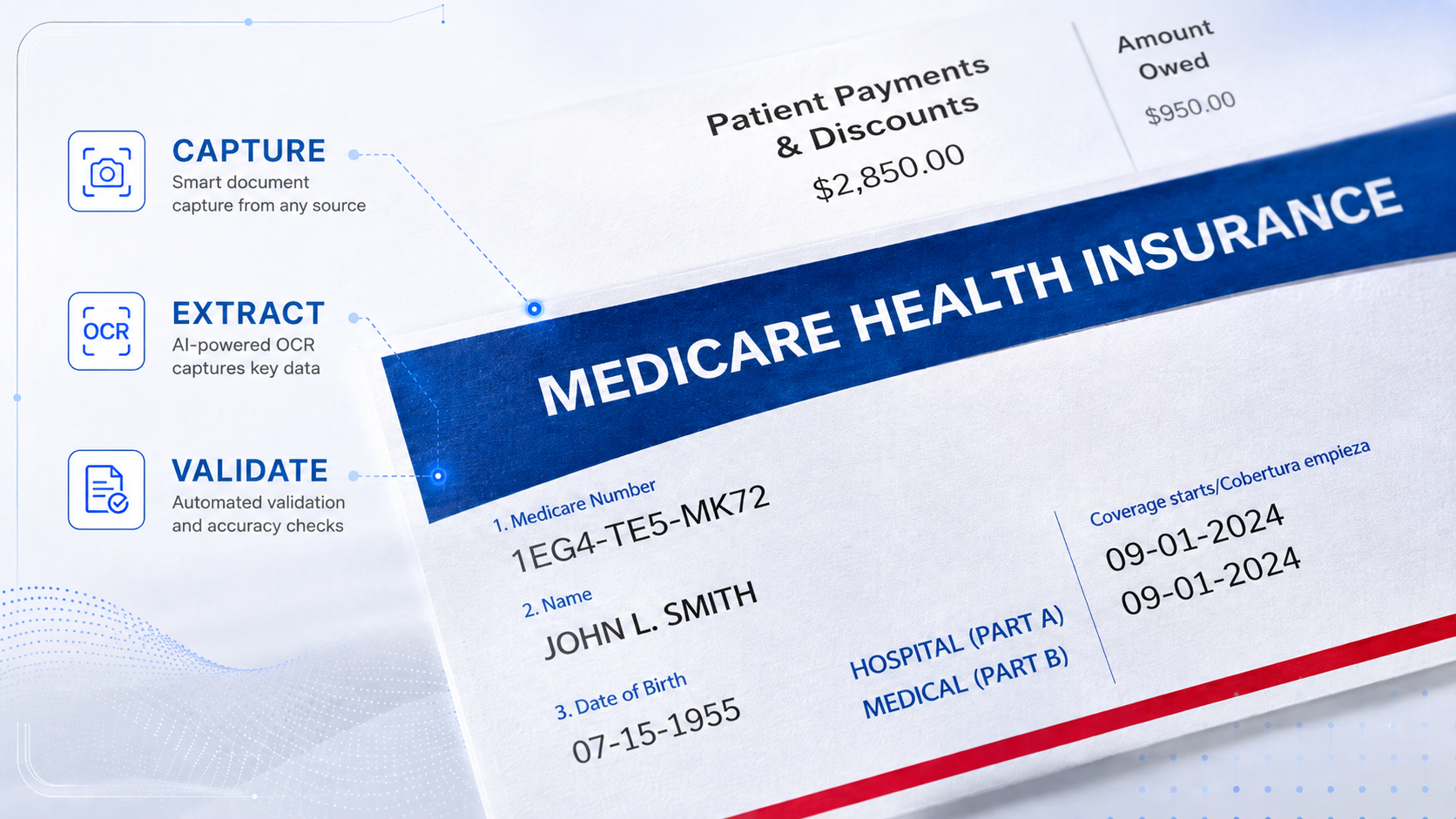
Explanation of Benefits (EOB) and Medicare Remittance Advice Notice (MRAN) documents are the backbone of claims reconciliation in healthcare billing. Every EOB ties a payer's payment decision back to a submitted claim. Every MRAN does the same for Medicare. The challenge is that these documents arrive in dozens of different layouts, with inconsistent field labels, missing values, and no universal standard for where critical data appears on the page. For claims processing teams handling thousands of these documents daily, accurate classification and data capture directly determines reimbursement speed, denial rates, and operational cost.
This guide breaks down the exact fields, rules, and classification logic that separate efficient EOB/MRAN processing from the manual grind most operations are stuck in.
Most claims processing workflows capture too many fields. Data Capture and Entry Teams key 15-20 data points per document when only four fields seem to really matter for accurate routing and reconciliation. Narrowing the focus to these four reduces manual entry time and cuts error rates.
The NPI is the single most valuable field on any EOB or MRAN. It links directly to provider and patient records in backend systems, which means capturing the NPI first can auto-populate insurance details, patient demographics, and billing addresses without additional keying.
Using the NPI as a primary lookup key also enables variant prediction. Different providers tend to receive specific EOB formats from specific payers. Tracking which variants appear per NPI allows processing teams to anticipate form layouts and pre-configure extraction rules, reducing classification time per document.
The filing date (or paid date) determines claim processing timelines, appeals windows, and denial deadlines. It is one of three fields in most EOBs that requires external validation against the original claim record. Missing or incorrect filing dates are a common cause of preventable denials.
For non-Medicare (other insurance) EOBs, the filing date and patient name are often the only two fields needed for accurate claim matching. Recognizing this simplification reduces workload significantly -- there is no need to capture every field on an Aetna or UnitedHealthcare EOB when only the date and patient name drive the match.
The MBI (formerly the HIC number) is the primary unique identifier for Medicare-related claims. Its strict 11-character alphanumeric format makes it a near-certain signal: if a document contains an 11-character MBI, it is almost certainly a Medicare document, regardless of what the form header says.
The complication is labeling. MBI rarely appears under a field labeled "MBI" or "Medicare Beneficiary Identifier." It is far more commonly labeled "Policy Number," "Subscriber ID," or "Member ID." Despite this inconsistency, the 11-character format combined with a form header referencing Medicare or CMS produces approximately 98% classification certainty for MRAN identification.
Medicare Advantage plans add complexity because they use commercial-style formatting while still being Medicare-associated. However, the MBI format check catches the vast majority of cases.
The ICN is the key that pairs an EOB with its corresponding claim in the billing system. Without accurate ICN capture, reconciliation relies on patient names and dates of service alone, which introduces mismatch risk when multiple claims share similar patient demographics or overlapping service periods.
ICN errors compound quickly. When providers consolidate multiple claims into a single submission, duplicate ICNs can appear in the system, making reconciliation difficult and sometimes requiring manual investigation. Emphasizing ICN comparison during data entry is one of the highest-impact accuracy improvements a processing team can make.
One of the most common classification questions in Medicare claims processing is whether an MRAN is a crossover or non-crossover document. The distinction matters because crossover MRANs require different data capture workflows and routing rules.
The classification rule is numeric and unambiguous:
This binary rule eliminates subjective judgment from the classification process. Data entry operators do not need to interpret ambiguous payment language or cross-reference external documentation. They check three numbers. If any number is greater than zero, it is a crossover. If all three are zero with SSA codes present, it is not.
Implementing this rule as a standard classification criterion reduces back-and-forth questions from operators and improves throughput consistency across shifts.
Unlike CMS-1500 and UB-04 claim forms, which follow federally mandated layouts, EOBs have no universal format standard. Each payer designs its own EOB layout, and many payers use multiple variants depending on the claim type, provider agreement, or processing system.
Claims processing teams typically encounter a manageable set of common EOB variants -- perhaps 15-25 that account for most of the incoming volume. Each variant has slightly different layouts, header structures, and detail line configurations. Some span multiple pages with consistent headers but varying detail sections. Others change layout entirely between pages.
The most effective approach is to catalog the high-frequency variants first. Tracking variant frequency by volume reveals which templates to prioritize for extraction rule development. In most operations, 5-10 common variants account for 60-80% of total document volume.
Payers do not use consistent labels for the same data. The NPI might appear as "Provider Number," "Billing NPI," "Rendering Provider," or simply "Provider #." The MBI appears under half a dozen different labels. Some forms omit the NPI field entirely, requiring fallback logic that searches for alternative identifiers.
This inconsistency is one of the biggest pain points in EOB processing. It means extraction rules cannot rely on field labels alone. Effective OCR-based capture systems need positional logic (where on the page does this field type typically appear?), format validation (does this value match the expected character pattern for an NPI or MBI?), and fallback hierarchies (if the NPI is missing, check for the Tax ID; if the MBI is missing, check for the HIC number).
For non-Medicare EOBs (commercial insurance, Medicaid managed care, etc.), the data capture requirement is far simpler. Only the filing or paid date and patient name are typically needed for claim matching. Recognizing key payer names -- Humana, UnitedHealthcare, Blue Cross Blue Shield (often abbreviated as BCBS), Cigna, Aetna -- at the top of the form immediately classifies the document as "other insurance" and triggers the simplified capture workflow.
This classification shortcut avoids unnecessary field captures and reduces per-document processing time for the large volume of non-Medicare EOBs that flow through most operations.
The classification rules and field priorities described above create clear pathways for automation.
Using the NPI as a lookup key in backend systems can auto-populate patient and insurance data, predict which EOB variants to expect for a given provider, and pre-select extraction templates before an operator touches the document. This single integration point can eliminate 30-50% of manual keying on a typical EOB.
Current tools in many claims processing environments are not optimized for this lookup. But the data connection is straightforward: NPI maps to provider, provider maps to typical payers, payers map to known EOB variants. Building this chain into the workflow reduces classification effort and improves first-pass accuracy.
Rather than applying generic OCR to every document, building dedicated extraction definitions for the 5-10 highest-volume EOB variants produces dramatically better results. Each definition specifies exact field locations, expected formats, and validation rules for that specific template.
This approach is testable and measurable. After implementing definitions for the top variants, teams can compare manual effort before and after to quantify the impact. In operations processing 50,000+ documents per month, even a 10-15% reduction in manual keying time translates to meaningful cost savings. For a real-world example, see how OCR Solutions processed over 4 million Medicare claims per month using dedicated extraction rules.
Some EOB formats lack explicit detail line tables, requiring the creation of synthetic detail lines to submit data correctly into downstream systems. Automation logic must accommodate these irregular layouts to prevent data loss or submission errors. This is one area where a verification station with human review remains essential -- fully automated extraction on irregular forms risks silent data loss that surfaces only as downstream denials.
An Explanation of Benefits (EOB) is a document from any insurance payer explaining how a claim was processed and what was paid. A Medicare Remittance Advice Notice (MRAN) is specifically a Medicare EOB, detailing Medicare's payment decision, including allowed amounts, deductibles, coinsurance, and any adjustments. MRANs follow Medicare-specific rules for crossover classification and require MBI-based identification.
The Medicare Beneficiary Identifier follows a strict 11-character alphanumeric format. Even when labeled as "Policy Number" or "Subscriber ID," a value matching this format combined with Medicare or CMS references in the form header provides approximately 98% classification certainty. Format validation is more reliable than label matching.
A crossover MRAN has at least one of three financial values greater than zero: provider paid amount, coinsurance, or deductible. If all three fields are zero or blank and SSA reason codes appear on each detail line, the MRAN is non-crossover. This numeric rule eliminates subjective classification decisions.
The Internal Control Number uniquely pairs an EOB with its corresponding claim in the billing system. Without accurate ICN matching, reconciliation depends on patient names and service dates, which creates mismatch risk when multiple claims share similar demographics. ICN errors are a leading cause of misapplied payments.
High-frequency EOB variants with consistent layouts can be automated using dedicated extraction definitions with template-based OCR, achieving 99% accuracy on structured fields. However, the diversity of EOB formats means a verification station for low-confidence fields and irregular layouts remains necessary. Full automation rates for EOBs are lower than for standardized forms like CMS-1500 or UB-04.
OCR document capture version 7.3 includes AI agents that are constantly learning the rules around the complexity of medical forms. AI is powerful for many tasks, but medical forms with constantly changing formats, rules, and requirements pose a real challenge. So far, applying business rules to this part of the process delivers the highest accuracy. As medical AI agents receive more training data, they will increasingly handle the classification and extraction work, reducing headcount requirements for claims processing operations.
