


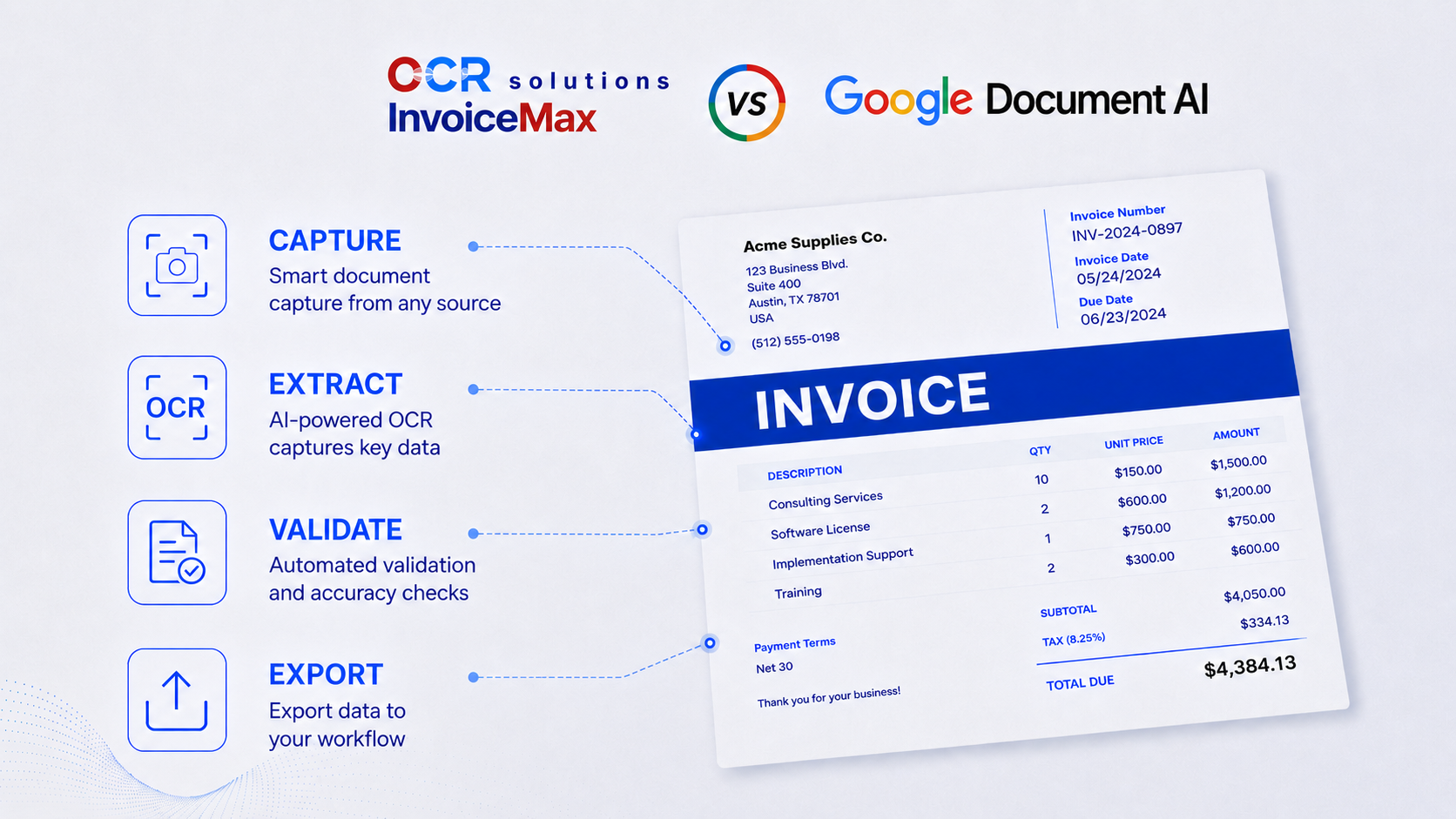
OCR Solutions InvoiceMax is accounts payable automation and invoice OCR software. It captures invoices of varying layouts (header data, line items, and totals), runs 2-way and 3-way matching, validates captured text with intelligent exception-highlighting, and exports both images and data automatically to your ERP and other systems. Google Cloud Document AI is a developer platform for document processing, and its Invoice Parser is a prebuilt processor that extracts fields and line items from invoices through an API on Google Cloud. Both read invoices and return the data in a structured, usable format. They differ most on scope and deployment: Document AI gives you an extraction API to build on, while OCR Solutions InvoiceMax is a full accounts payable workflow that runs on-premise or in the cloud based on your requirements.
This page compares the two by use case, not to crown a single winner but to help you see which system best fits your needs. For the wider picture of where InvoiceMax sits in an accounts payable stack, see the AP automation overview. Below, Google Document AI gets credit for what it genuinely does well, then we compare the workflow where teams may need more than a general extraction API.
Before the differences, it helps to be clear on the overlap. OCR Solutions InvoiceMax and Google Document AI both turn an invoice into structured data: they read the header fields, the line items, and the totals that a person used to key in by hand, and both expose that through a developer interface (Document AI through its API and client libraries, InvoiceMax through its SDK and API). Both can handle varied layouts without a hand-built template per vendor, and both are built to run at volume. If your only goal is to pull clean fields off an invoice and get structured data back, either one clears that bar. The decision comes down to what happens after extraction, and where the software is allowed to run: Document AI hands you data to build on, while InvoiceMax carries the invoice through database matching, exception review, and posting to your ERP, on-premise if you need to keep your data and your clients' data under your own control.
Google Document AI earned its place for good reasons, and an honest comparison starts there.
For a developer team that already builds on Google Cloud and wants a capable extraction API to wire into its own pipeline, Document AI is a strong contender. Nothing below is meant to argue otherwise.
Teams usually start looking for more when specific workflow requirements show up. General capture is great if that is all you need, but the advanced functionality is where InvoiceMax shows its strengths. These are scope and deployment limits, not flaws in the extraction itself.
Those points are about scope and where the software runs, not about whether the extraction is good. They are where OCR Solutions InvoiceMax is built differently.
OCR Solutions InvoiceMax is AP automation and invoice OCR software from OCR Solutions, a vendor founded in 2004 that also builds ID-reading and medical-claims products. Its job is the whole capture-to-export path of accounts payable: read the invoice accurately, match it, flag the exceptions, and hand clean data to your ERP.
InvoiceMax also includes AI agents that learn your industry's requirements. Each agent starts as a blank slate and adapts to the client's business as it goes, taking on more of the verification work over time.
InvoiceMax's recognition accuracy is built on image-cleanup algorithms refined over 20 years, typically running 97%+ depending on document quality. Our rule of thumb: if a person can read a document, InvoiceMax generally can too. Harder documents just need a little context from your team up front, since nobody knows your invoices better than you do.
On clean invoices, InvoiceMax reaches roughly 90% straight-through processing, meaning about 9 out of 10 invoices flow through with no human touch.
Google Document AI runs in Google Cloud. Invoices are sent to the API, processed on Google's infrastructure, and returned as structured data. For a team already on Google Cloud that is an advantage: nothing to host, elastic scale, and the rest of GCP close at hand. It becomes a constraint only when something outside the software requires it, such as a data-residency rule, a security policy that keeps financial documents inside your own network, or an environment that is partly or fully offline.
OCR Solutions InvoiceMax is built to run where you need it, including on-premise and offline. The capture engine can sit inside your own infrastructure, so invoice images and extracted data do not have to leave your network to be processed. For a finance team in a regulated industry, a company with strict data-handling commitments, or an operation that cannot depend on a constant cloud connection, that difference outweighs most feature-by-feature points. It is the single clearest reason a team picks InvoiceMax over a cloud-only extraction API when the need is a full AP workflow rather than a component to build around.
Pricing here is about model and structure, not specific numbers. Google Document AI uses usage-based pricing: you pay for each document processed on Google Cloud, plus whatever the surrounding Google Cloud services cost, which can make the all-in total hard to estimate as volume and your cloud footprint grow. OCR Solutions InvoiceMax uses flexible licensing rather than per-seat SaaS or per-document cloud pricing, so cost does not climb simply because you add AP reviewers, and a full workflow is included rather than assembled from parts. It is priced mostly on yearly volume, with custom terms available. Which model is cheaper depends entirely on your volumes, your team size, and how much you would otherwise build around an API.
Google Document AI vs OCR Solutions InvoiceMax at a glance
| Dimension | Google Document AI | OCR Solutions InvoiceMax |
|---|---|---|
| Category | Cloud document-understanding API (Invoice Parser) on Google Cloud | AP automation and invoice OCR (capture into your ERP) |
| Output | Structured data via API (you build the last mile) | Full AP workflow: capture, matching, exception routing, customizable export |
| Deployment | Cloud only (Google Cloud) | Cloud, on-premise, or offline |
| Invoice capture | Prebuilt Invoice Parser plus custom processors | Template-free capture of varied layouts, customizable if needed |
| Matching | Not included; build your own | Built-in 2-way and 3-way matching |
| ERP integrations | None native; you build the integration | SAP, QuickBooks, Acumatica, Sage, NetSuite, Microsoft Dynamics, and more via proprietary connectors |
| Embedding (SDK / API) | API and client libraries (developer-first) | SDK and API for easy integration |
| Pricing model | Usage-based per document on Google Cloud (hard to estimate at scale) | Flexible licensing based on yearly volume, no per-seat fees (price not publicly published) |
| Setup | Google Cloud project, IAM, and billing | Deploy in your own environment or cloud, or use OCR's SOC 2 certified cloud |
| Reviews / install base | Part of Google Cloud (vendor-reported) | Not publicly published |
| Best fit | Custom extraction pipelines on Google Cloud | On-prem or SDK capture with a full AP workflow; security- and privacy-focused |
Yes, when you need more than extraction. OCR Solutions InvoiceMax is AP automation and invoice OCR software that reads invoices, runs 2-way and 3-way matching, routes exceptions, and exports to your ERP. Google Document AI gives you a strong extraction API and leaves the matching, approvals, and ERP posting for you to build. InvoiceMax is the closest fit when you want that full workflow, or when you need on-premise deployment, which Document AI does not offer.
Google Document AI extracts fields and line items from an invoice and returns structured data. A full AP workflow, like OCR Solutions InvoiceMax, takes the invoice further: it matches against purchase orders and receipts, routes low-confidence fields and exceptions for review, and posts clean data to your ERP. With Document AI you build those steps yourself; with InvoiceMax they are part of the product.
Yes. InvoiceMax supports on-premise and offline deployment, so invoice and vendor data can stay inside your own environment. Google Document AI processes documents in Google Cloud.
Yes. 2-way and 3-way matching are built into InvoiceMax, so invoices are checked against your database for purchase orders and receipts before the data is exported to your ERP. Google Document AI does not do matching; it returns extracted data for you to match downstream.
It exports to ERP systems including SAP, QuickBooks, Acumatica, Sage, NetSuite, and Microsoft Dynamics, with more supported through proprietary connectors. Google Document AI has no native ERP export; that integration is yours to build.
Yes. InvoiceMax offers an SDK and API so developers can integrate invoice capture into an existing application or workflow. If a pure developer API is all you want, Google Document AI is built that way too; the difference is how much of the AP workflow comes with it.
No. InvoiceMax can run in your own environment, on-premise or offline, or in the cloud you choose. Google Document AI runs on Google Cloud and expects a project, permissions, and billing to be set up.
InvoiceMax's recognition accuracy is built on image-cleanup algorithms refined over 20 years, typically running 97%+ depending on document quality. On clean invoices, it reaches roughly 90% straight-through processing, meaning about 9 out of 10 invoices flow through with no human touch.
Google Document AI and OCR Solutions InvoiceMax solve different parts of the same problem: one is an extraction API you build a workflow around, the other is the workflow. If you are building a custom pipeline on Google Cloud and want control over every step, the API earns its place; if you want capture, matching, and ERP export as one product, on-premise when you need it, the full tool wins. Choose Google Document AI to build custom invoice extraction on Google Cloud. Choose OCR Solutions InvoiceMax for a full on-prem AP workflow with built-in matching and ERP export.
Request a customized demo and run OCR Solutions InvoiceMax against a sample of your real invoices to see the capture, matching, and export on your own layouts, without building the workflow yourself.
Already calling Google Document AI? You do not have to switch anything to evaluate. Test InvoiceMax capture and matching alongside your current pipeline first. When you are ready to plan an actual move, our AP migration team walks you through the switching steps.
